
Autistic Adults need to tell their own stories
By: Andrew Penalosa
April 21, 2025
Story Highlights
- There is a systematic problem when it comes to autism representation by the media according to Alex Hayslip, founder of San Diego Autism Society’s Spectrum Social.
- “At the end of the day, they have those challenges because of their diagnosis and it shouldn’t be highlighted to make money off of like I know the actors get paid, but it’s a little messed up,” said Bella Biunno, board member of Mentoring Autistic Minds.
- “There’s no perfect situation where only people on the spectrum can tell their stories, or only the media can tell their stories. I think both can work together,” said Assistant Journalism Professor Lourdes Miram Chacón, media scholar at San Diego State University.

SAN DIEGO-When an autistic adult is being represented in the media, there are a range of roles of how they are being represented. Some are portrayed as people that are to be pitied, those who are played for laughs, those who are taken advantage of, and those who have one defining personality trait. Autistic individuals and people who work with them don’t appreciate the ways they are being represented by the media.
They believe that autistic individuals are like neurotypical people, but with certain difficulties. They strive when it comes to academics, but struggle with social activity. Making friends and understanding social cues don’t come naturally to autistic adults. However, it shouldn’t be the only thing an autistic adult should be portrayed as in the media. For example, the character Raymond Babbitt from “Rain Man” is portrayed as someone who has extraordinary mathematical capabilities. The issue is that not all autistic people have great math skills and it paints a stereotypical picture that all autistic people are great in mathematics.
Another example is music from the movie, “Music.” The character is used as a plot prop. She is given no personality and she had to be restrained when she was having a meltdown. Not all autistic people need to be restrained when a meltdown occurs. There are healthy ways to calm down an autistic person when a meltdown happens like creating a safe space and deep breaths.
Bad vs. Good Autism Media Representation
Media representation of Autism has varied in various shows. For example, “Atypical” represents Sam as an autistic individual who is used as someone to be made fun of. The sources that were used were from Fraser.org, The Science Survey, news articles from NBC and Today about Bella Ramsey and Tony Snell, and from the interviewees. These sources tied into the issue of not having autistic adults tell their story and it was easier to find examples of bad representation compared to good representation.
Several characters have received praise by the autism community for accurate representations. The Pixar short, “Loop,” had a nonverbal character that was accurately portrayed with repetitive behavior and how her partner had a hard time understanding what she wanted. The shocking part about the infographic was having the character, Dr. Shaun Murphy, in the middle.
There are two different perspectives of Murphy being a good and bad representation from enna.org and autismspeaks.org. enna.org described him as a negative representation as he reinforced stereotypes of autistic individuals being “socially awkward and difficult to communicate with.” Autismspeaks.org had a blog post about the character and the author, Kerry Magro, said that the show walks the razor’s edge of accurate representation of Dr. Murphy.
Full infographic here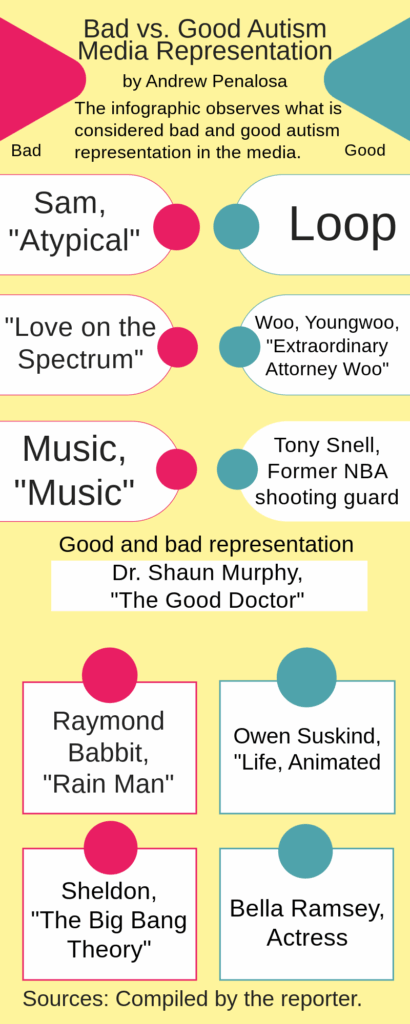
Autistic Perspective on Representation in the Media
Alex Hayslip, an autistic adult who is a founder of San Diego Autism Society’s Spectrum Social and San Diego State University alumni, feels like there is a systematic problem for representing people on the spectrum. One example that came to mind was a show on Netflix called “Atypical” and Hayslip didn’t like how the main character, Sam, was portrayed.
“The way that they wrote that show made the person with (autism) is a part of the joke in the sense that a lot of the humor wasn’t necessarily funny,” said Hayslip. “It was basically laugh at this person who has autism. They’re weird. That was the extent of the humor.”
Hayslip collaborated with David Rivera, president and founder of Mentoring Autistic Minds as he took part of a podcast in Fall 2023 discussing about his personal life with autism and offered advice for parents with autistic children. He also formed a group called San Diego Autism Society’s Spectrum Social where they talk about what’s going on in their lives and discuss positive and negative autism representation in the media.
Hayslip says the autistic community needs to be involved in the creative process of the show or have an autistic actor portray the character. The one person he referred to was actress, Bella Ramsey. According to Terry Dickerson of NBC News, Ramsey was diagnosed with autism when she was filming “The Last of Us” after a crew member spotted signs. Hayslip feels like someone like Ramsey should be an example for autistic actors portraying autistic characters.
Another person Hayslip recalled was former NBA shooting guard, Tony Snell. According to Caroline Kee of Today, Snell was diagnosed with autism after learning that his son was diagnosed with autism. When asked if Hayslip were to ask Snell one question if a movie was made about him, his response was candid.
“I’d ask him, ‘What does he want the general public to know as the result of him publicly revealing his official diagnosis?’” Hayslip said.
This is just one perspective on the issue of autism representation. The next perspective comes from someone who has worked with autistic adults.
Ally Perspective on Autistic Representation
Bella Biunno, third-year psychology major at San Diego State University and managing editor of The Daily Aztec, works with autistic adults as she volunteers with local autism organizations like Autism Tree Project Foundation. She is also a board member of Mentoring Autistic Minds where they hold social events, workshops, and provide mentorships to autistic adults.
Biunno believes that the media portrays autism on a severe level like focusing on autistic behaviors which are covering ears and struggling with social conversations. She often views it as a pie, different slices of people on the spectrum and it should not be viewed as a linear line.
Biunno said she was hosting a workshop with autistic adults. Several planes passed by the area, she asked if everyone would be comfortable moving to a quiet place, and they were okay. She provided a great example of how the media could portray her situation.
“If they were to film that exact scene, I think they would have everybody appearing overstimulated, covering their ears, putting on headphones, things like that,” said Biunno. “But in reality everyone was OK and they’ve lived with those sensory sensitivities for long enough.”
As a journalist, Biunno wants to advocate for people on the spectrum through writing and analyzing films that portray autism. One show that Biunno was critical about was “Love on the Spectrum” on Netflix. She thought that people who weren’t on the spectrum found it entertaining because of the social challenges that autistic adults suffer through and she found it demeaning.
“I do think shows like (Love on the Spectrum) could be a little demeaning just because you know you don’t want to use someone’s disability as entertainment, right?” said Buinno. “At the end of the day, they have those challenges because of their diagnosis and it shouldn’t be highlighted to make money off of like I know the actors get paid, but it’s a little messed up.”
After gaining another perspective from Biunno, the next perspective provides a different viewpoint on the issue with autism representation in the media.
Shade of Grey: Differing Portrayals
San Diego State University Journalism Assistant Professor Lourdes Miriam Cueva Chacón, who is also a media scholar, has a different perspective on autism representation. Chacón is aware that the media has not done a good job portraying people on the spectrum, but she believes that there is still a good way to portray autistic adults through proper guidance and training. Chacón also believes that people on the spectrum should not be the only way to portray accurate representation.
“There’s no perfect situation where only people on the spectrum can tell their stories, or only the media can tell their stories. I think both can work together,” said Chacón “(People on the spectrum) can work along with media practitioners to tell their stories.”
According to a report from the Centers for Disease Control from the California Autism and Developmental Disabilities Monitoring (CA-ADDM) program from 2020, white children were less likely to be identified than other races and ethnicities. Another statistic from the report was that the median age for diagnosis in eight-year-old children in California was 36 months compared to 49 months for the U.S in 2020.
The one that was surprising was that Asian/Pacific Islanders eight-year-old children were 1.5 times as likely to be identified with autism compared to the other races in California. There are multiple layers to the issue and another way to look at this would be through a media scholar.
Chacon recalled a movie called “Rain Man” where Raymond Babbitt, played by Dustin Hoffman, had autism and was watched over by Charlie Babbitt, played by Tom Cruise. She said that the movie made neurotypical people feel good about the character, but according to an article from Ennaglobal, that was categorized as negative representation.
This was considered an improvement from Chacón’s point of view. Chacón sees that the pool of autistic actors is small compared to other racial groups and no effort is made to find them.
“There has not been enough effort into looking for (autistic actors) and also training them the same way that there are academies for the rest of people,” Chacón said.
Conclusion
It may take time, patience, acceptance and understanding to have autistic adults tell their stories. There will be skepticism if it can be accomplished, but that doesn’t mean it can’t be done. If the media and autistic individuals collaborate during the creative process, there can be a reality where autistic adults can tell their stories accurately and respectfully.